The Holocaust
Midwinter BreakThe Holocaust enters the novel not as a broad historical account but as an encounter with material traces of murdered lives and with the uneasy obligations of remembrance. At Buchenwald, Gerry is struck by the contrast between the remains on display and schoolchildren methodically completing exercises. At the Anne Frank House, Stella answers an improvised memorial with an offering of her own, then worries that her gesture presumes too much. Together, these responses distinguish witnessing from merely collecting information, while leaving open who has the right to speak for suffering.
Evidence and the School Visit
Gerry recalls the schools at Buchenwald as the worst part of the visit. The children carried jotters and clipboards, ticking boxes and trying to get the answers right. Their teachers had warned them to be quiet, and the groups moved through the site with the hushed order of a library. The calm, routine quality of the exercise unsettles Gerry: the students appear to approach the place as an ordinary assignment, even as they pass evidence of extraordinary human loss.
The exhibits he names make that contrast brutally concrete: rooms full of human hair, piles of shoes reaching the ceiling, and a crate of rings. Gerry lingers on the wedding rings, asking how long it would take to fill a container of that size. His attention to the accumulation turns an inventory into a measure of individual lives: each ring belonged to someone, while the crate’s scale makes the number of people behind the objects difficult to comprehend. The question does not resolve that difficulty; it gives it a physical form.
Remembering Anne Frank
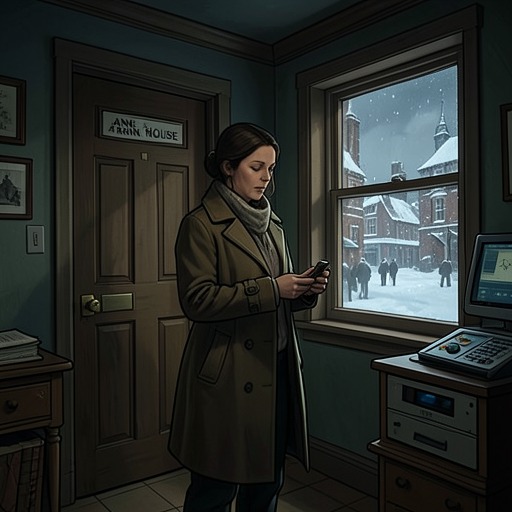
At the Anne Frank House, Stella sees a small line of objects on a mantelpiece. The offering appears informal and recent, perhaps begun by a child and continued by others in the school party. To Stella, it is a salute to those who suffered and a means of identifying with the dead and wounded. She thinks of Anne Frank’s Jewishness and death in a concentration camp, as well as the yearnings in Anne’s life that Stella recognizes. The suffering surrounding Anne’s death, she feels, cannot be adequately conveyed by what is written there.
Stella’s response is shaped by a visit that has affected her before. She tells Gerry that she used to teach the book to many school classes, but the house, the pictures of Anne, and its memories still leave her deeply shaken. Seeing the tokens makes her want to leave something, and she chooses an earring. The encounter thus joins public remembrance to an intimate history of reading and teaching: familiarity with the story has not made its human cost remote or exhausted its power to move her.
The Earring as Offering
The earring Stella leaves is an eternity ring. Its meaning reaches back to her childhood, when the idea of eternity frightened her: she remembers lying in bed unable to imagine the end of time, and the Catechism’s language of everlasting life. At the mantelpiece, the small gold circle rocks briefly before coming to rest at the end of the line of tokens. A private object, marked by her own history, becomes part of a collective gesture toward people she never knew.
Stella bows her head and prays. She understands the act less as a formal prayer than as solidarity: an expression of gratitude and appreciation for a life cut short, and of common humanity across different faiths and generations. In her inward address, Anne is a young casualty and Stella an old survivor, lives at opposite ends of life joined by suffering. The offering does not claim that their experiences are equivalent. Instead, its force lies in Stella’s attempt to acknowledge a connection while preserving the difference between them.
The Limits of Identification
Afterward, Stella tells Gerry that she should not have left the earring. She clenches her fists and explains that she is not Jewish and has not been involved in anything like the family’s suffering; to offer a token seems arrogant in light of what they endured. She invokes Gerry’s phrase about the Pain Club to insist that she is not entitled to membership in another people’s grief. Her hesitation complicates the gesture without erasing it: the earring has already been left, but Stella refuses to treat compassion as a license to claim another person’s history.
The two encounters therefore present different dangers in remembering. Gerry fears that the school visit’s worksheets and correct answers can make atrocity feel like a normal task; Stella fears that personal identification can overstep the boundary between solidarity and appropriation. Neither response supplies an easy solution. The Holocaust remains present through the objects that testify to lives destroyed, through the educational rituals surrounding them, and through the small, contested actions by which survivors and later visitors try to honor the dead.